Nearly every parent we say this to is surprised by it, and a good number ring back to check we meant it. We did.
The answer, and where it comes from
The American Academy of Pediatric Dentistry puts the first dental visit at twelve months of age, or within six months of the first tooth erupting, whichever comes first. The American Academy of Pediatrics says the same. This is not a practice policy invented to fill a diary — it is the guidance, and it has been the guidance for a long time.
Most adults reading this went for the first time at four or five, once there was a full set of teeth and something worth looking at. That is the model the age-one visit replaced, for reasons that are easier to see once you know what the appointment is actually like.
What a one-year-old appointment actually is
Here is the honest description: a half-hour conversation with a two-minute examination in the middle of it. We are not expecting to find much at twelve months, and most of the time we do not find anything at all. The value is in what you walk out with.
The knee-to-knee exam
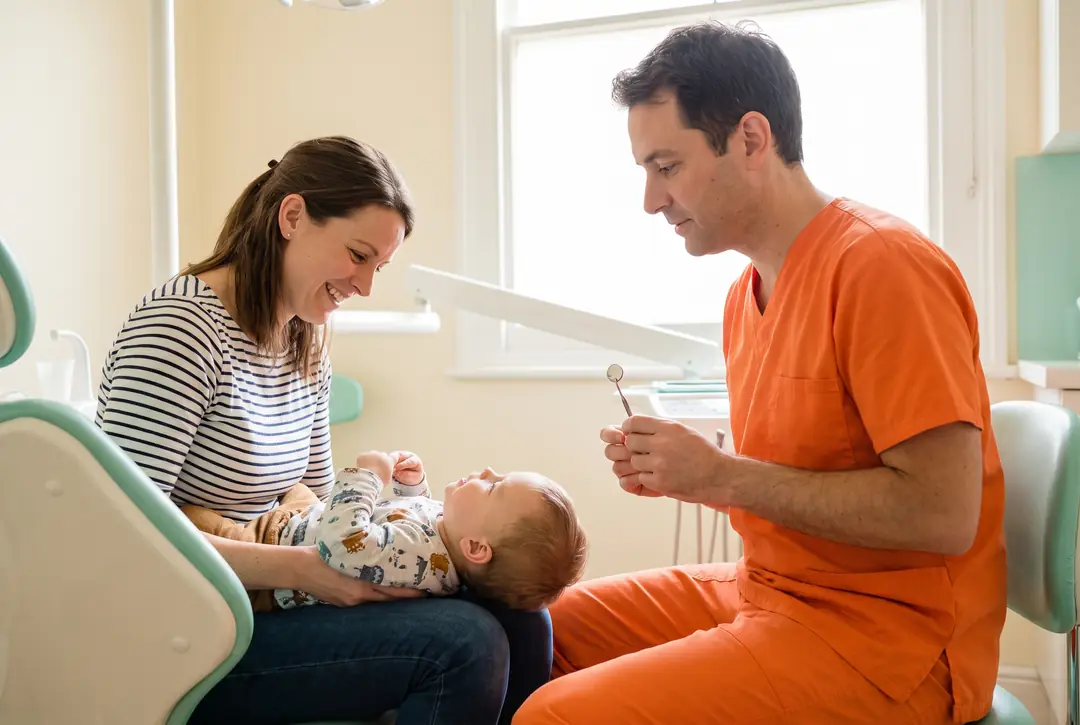
You sit facing the dentist with your knees touching theirs, and your child lies back across your lap into ours, looking straight up at your face the entire time. It gives us a clear view of the upper front teeth and the gum line — which is exactly where decay in very small children shows itself first — and it gives your child something far better to look at than a light.
Some one-year-olds cry through it. That is not a failed appointment and it is not a badly behaved child; it is a one-year-old being held on their back, which is a thing they are entitled to have opinions about. We can see everything we need to see either way, and a crying child, inconveniently for everyone, gives an excellent view.
Feeding, bottles and cups
Usually the longest part of the visit. We will ask what your child drinks, when, and out of what: bottles at bedtime, milk through the night, juice in a cup carried around all morning, feeding on demand overnight now that teeth are through. Those patterns move a small child's decay risk more than almost anything else, and they are far easier to change at one than at three. We are not there to make anyone feel bad. Most families change one thing, not five.
Brushing, demonstrated on your own child
Someone will brush your child's teeth in front of you, then hand you the brush and watch you do it, because reading about the position and being put in the position are not the same experience. Twice a day, from the first tooth, with a fluoride toothpaste and a smear about the size of a grain of rice. There is a great deal more on that in brushing without a battle.
Fluoride varnish and a risk assessment
Most children have fluoride varnish at this visit: a sticky, quick-setting fluoride painted on with a small brush, about a minute of work, set by contact with saliva. Soft food for a couple of hours afterwards, and leave the brushing until the next morning.
Then we do a caries-risk assessment, which is a formal name for a plain judgement — what we can see, what your child eats and drinks, whether older siblings or parents have had a lot of decay, whether your water is fluoridated, and how brushing is honestly going. That judgement sets how often we want to see you. Six months suits most children; some we would rather see every three or four.
The whole appointment is written out step by step, in words a small child can follow, on the first visit page — and the clinical detail sits under first visits and check-ups.
Why age one and not age three
Four reasons, in the order they matter.
- Decay can start as soon as there are teeth to decay. Early childhood caries is not rare and it does not politely wait for a full set. We see cavities in two-year-olds. A single early lesion found at two is a short conversation and a change to a routine; four cavities found at four is often treatment under sedation or a general anaesthetic.
- Habits are easier to change before they are habits. A bottle at bedtime is a small adjustment at eleven months, a difficult one at two, and a nightly negotiation at four.
- A child who has met a dentist is not frightened of one. Start at one and by the time they are four they have had five or six appointments in which nothing whatsoever happened. Start at four and the first visit is often prompted by something hurting, which is the worst possible introduction to us.
- Some of what we check is not the teeth. Eruption pattern, how the tongue and lips move, an injury from learning to walk, a thumb or dummy habit starting to change the shape of the bite.
What to do the night before
Considerably less than most parents expect.
- Book around the nap rather than through it. Late morning suits most one-year-olds.
- Normal bedtime, normal breakfast. Do not let the day feel like a special occasion.
- Do not over-prepare. "We are going to see someone who counts your teeth" is enough of a briefing.
- Avoid the words hurt, needle, shot, drill and pull — including in a sentence promising that none of them will happen. The words plant the idea; the sentence around them does not remove it.
- Bring the comforter, the blanket, the dummy, whatever it is. Bring a bottle if that is the routine.
- Bring your Medicaid or insurance card and a list of any medicines. Cover can be checked before you arrive — see insurance and Medicaid.
- Arrive ten minutes early, so that paperwork time is not appointment time.
And afterwards
You go home with what we actually saw, written down rather than summarised at the door, the one or two things we would change first, and the next check-up booked. If we found something, we will tell you what it is, what we would do about it, and what happens if we do nothing yet.
One last thing, because it comes up most weeks. If your child is already three, or six, or eleven, and has never seen a dentist, that is a very ordinary phone call and nobody here will comment on it. Ring us and we will start from where you are.