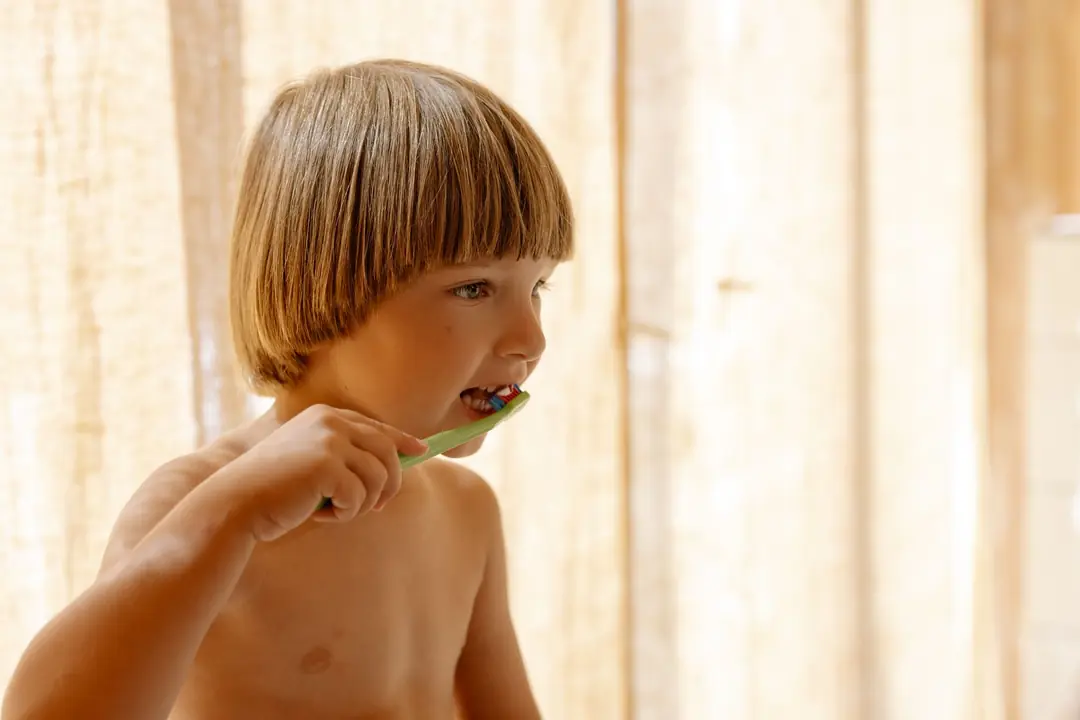
I coach brushing all day, and the thing I say most often is that the parents who feel worst about it are usually doing better than they think. What follows is the small number of things that genuinely change whether a child gets cavities, and then the much longer list of things you are allowed to give up on.
The five things that actually matter
Twice a day, two minutes
Two minutes is far longer than it feels. Almost everybody who has not timed it is brushing for about forty seconds. Use the timer on your phone, a sand timer stuck to the tiles, one song, or the two-minute counter on our games and brushing chart page. What the timer is really doing is stopping the adult from finishing early, not the child.
How much toothpaste
Fluoride toothpaste from the very first tooth. Under three, a smear the size of a grain of rice — genuinely that little, which surprises people who have seen the swirl of paste in the advertisements. From three, a pea-sized amount. Any family toothpaste with fluoride in it is fine; the flavour is your child's business and the fluoride is ours.
Who is holding the brush
An adult should be brushing, or going over it properly afterwards, until roughly the age of seven or eight. This is not about willingness. It is manual dexterity: cleaning the inside surface of a lower back molar is a fiddly, two-directional movement, and a child who cannot yet tie their own laces or write neatly cannot reliably do it either. They can do the front teeth beautifully and miss the ones that get the cavities.
The night-time brush is the important one
Saliva flow drops while we sleep, and saliva is what washes and buffers the mouth. Whatever is left on the teeth at bedtime sits there for eight or nine hours with nothing diluting it. So: brush last thing, after the last drink and the last snack, and after that nothing but water. If only one brush is going to happen on a bad day, make it that one.
Spit, do not rinse
When they are done, have them spit the foam out and stop there. Rinsing with water washes the fluoride straight off the teeth, which throws away most of the reason for using the toothpaste. Same with a mouthwash immediately afterwards — if you use one at all, use it at a different time of day.
The position nobody mentions
Standing in front of a child and brushing towards yourself is the hardest possible way to do this, and it is how nearly everyone starts. Stand or sit behind them instead, tilt their head back against your body, and work from above. You can see the biting surfaces, your hand is at the angle it would be in your own mouth, and their head is supported rather than dodging.
For a toddler, lie them on the floor or on a bed with their head in your lap, looking up at you. It reads strangely and it is far and away the easiest method. Start at the back teeth on one side and work round in the same order every night, so an interruption does not lose your place. Small circles, bristles angled at the line where tooth meets gum, which is where the plaque lives.
Making it a routine instead of a fight
- Let them go first, then you check. They brush their own teeth for as long as they like, and then you have your turn, which is the turn that counts. Calling it checking rather than doing keeps the ownership with them.
- Same slot, every night. Attach it to something that already happens — before pyjamas, after the bath — rather than making it the last hurdle before bed, when everyone is out of patience.
- Choose a battle to lose. Let them pick the flavour, the colour of the brush, which parent does it, standing or lying down, the song, the order. What is not on the list is whether it happens at all. Children who are given four real choices argue much less about the fifth thing that is not a choice.
- A chart, if charts work in your house. Ours is on the kids' page, along with a two-minute timer game. If charts do not work in your house, skip it; nobody has ever prevented a cavity with a sticker alone.
- Never use us as the threat. "The dentist will be cross" makes our job harder and does nothing for yours. We would rather be the people with the treasure box.
When it goes wrong anyway
A child who fights it every single night is not evidence of a parenting failure. Some of them hate the sensation, some hate the loss of control, and some are two. Things worth trying, in roughly this order: a different flavour, a non-mint or non-foaming toothpaste, a smaller and softer brush head, an electric brush or specifically not an electric brush, brushing in the bath, brushing at a completely different time of day, or letting them brush your teeth first.
And if you get twenty seconds on a given night, take the twenty seconds and aim them at the gum line of the back teeth. Twenty honest seconds is worth considerably more than an argument that ends with nothing brushed and everyone upset. Tomorrow is another go.
If the difficulty is sensory rather than behavioural, say so and we will treat it as such — different textures, different toothpaste, a plan built in stages. That is what our special needs and sensory-friendly care is for, and it applies to brushing at home as much as to the chair.
Flossing, and everything else
Floss where two teeth touch, because a brush cannot get in there. For most children that means the back teeth, once those contacts close up, and floss sticks are easier than string for an adult reaching into a small mouth. Mouthwash is generally not needed for young children and never replaces brushing.
The other half of the job is not brushing at all: it is how often sugar goes in, rather than how much. Sipping juice across an afternoon is harder on teeth than a pudding at the end of a meal. We go through all of it, without a lecture, at every check-up — see cleanings, fluoride and sealants for the rest of what we do.