Bright LittleDentistry for children

First visits

What happens when you come here

Told twice on this page: once in words for a child to follow, and once in the detail a parent is actually looking for. Read the picture story out loud — it is written to be read out loud.

1

By the first birthday

Or within six months of the first tooth arriving — whichever comes first. That is the American Academy of Pediatric Dentistry recommendation, and it is not about the teeth. It is about catching feeding and brushing habits while they are still new, and about a four-year-old who is not frightened because a one-year-old already came here.

30

Minutes, roughly

Longer than we need, on purpose. A rushed first appointment costs you every appointment after it. Most of the time is spent talking to you and letting your child work out that the room is not frightening.

0

Things we will do without asking

Nothing goes near your child without them being told what it is first. They get a stop signal — a hand in the air — and we stop when they use it. Every single time, or the signal is worthless.

Your visit, in nine pictures

  1. Step 1. You come in and say hello

    The door has a bell on it. Someone at the desk will say your name and ask you how old you are. There are books, and blocks, and a fish called Kevin.

    Come ten minutes early so the paperwork happens outside your appointment time. If your child needs to just sit and watch for a bit before we call them, tell us and we will wait.

  2. Step 2. We talk before we look

    We ask you things first. What you had for breakfast. Whether you have a wobbly one. Nobody looks in your mouth until you have said it is all right.

    We take a medical history, ask about feeding, bottles, dummies, thumb habits and what your water supply is. We also ask how previous appointments went, because that tells us how to plan this one.

  3. Step 3. The chair goes up and down

    The big chair moves. You get to press the button. If you would rather sit on your grown-up instead, that is completely allowed.

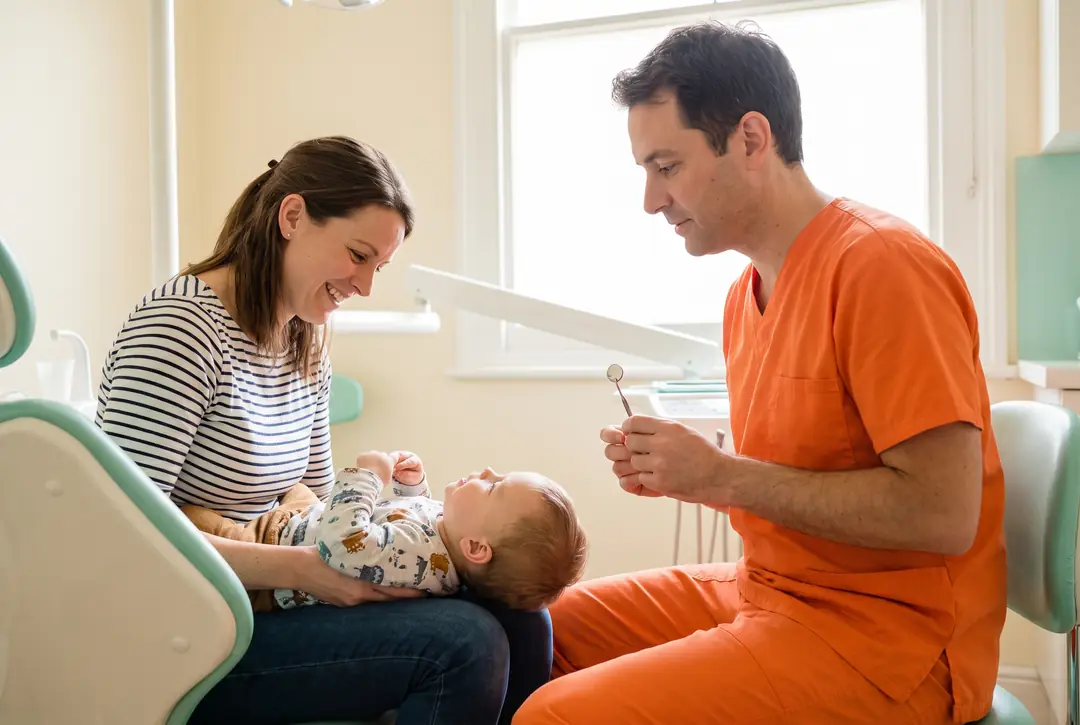
    Under three, we do a knee-to-knee exam: you sit facing the dentist, your child lies back from your lap into theirs, and they can see your face the whole time. It takes about ninety seconds.

  4. Step 4. Sunglasses on

    The light above the chair is very bright, so you get sunglasses. You can pick which ones.

    The glasses are for glare and for splatter. Children who dislike them do not have to wear them; we angle the light instead.

  5. Step 5. We count your teeth

    We count them out loud with a tiny mirror. You can hold the mirror and watch. Some people have four teeth, some have twenty. All of those are fine.

    This is the examination: soft tissues, eruption sequence, occlusion, plaque and gingival health, and a caries-risk assessment. It just does not look like an examination, which is the point.

  6. Step 6. The tickly toothbrush

    A little brush that spins and tickles. It tastes like bubblegum, or strawberry, or mint. You choose the flavour.

    A prophylaxis with a rubber cup and paste. For very young or wary children we sometimes brush with a normal toothbrush instead — the cleaning matters more than the equipment.

  7. Step 7. The shiny paint

    A tiny paintbrush puts sticky vitamins on your teeth. It sets straight away and tastes a bit sweet.

    Fluoride varnish — 5% sodium fluoride, applied in about a minute. Soft food for a couple of hours and skip brushing until the next morning so it stays where we put it.

  8. Step 8. We tell your grown-up what we saw

    While you get down from the chair we tell your grown-up about your teeth. You can listen. If we found something, we will tell you too, in normal words.

    You get a plain-English summary of what we found, what we recommend, and a written estimate for anything beyond the check-up. If we saw nothing, we will say so and not invent work.

  9. Step 9. You choose a prize

    You did it. The treasure box lives by the desk and you get to pick one thing out of it. Even if you only managed to sit down.

    And we book the next visit before you leave. Six months for most children; sooner if the caries-risk assessment says sooner.

The night before

The words you use at home matter more than anything we do

The single biggest predictor of how a first visit goes is what a child has already been told. A child who arrives having been reassured that "it will not hurt" has spent the car journey wondering why anyone would need to say that.

Worth saying

  • "The dentist is going to count your teeth."
  • "You can sit on my lap if you want to."
  • "There is a treasure box at the end."
  • "If you want them to stop, you put your hand up."
  • "I do not know exactly, we will find out together."

Better left out

  • "It will not hurt." — it plants the idea it might.
  • Needle, drill, pull, injection, shot.
  • "Be brave." — bravery implies something to fear.
  • Your own dental horror stories. They are contagious.
  • Promising there will be no treatment. You cannot know.
A toddler lying back from their mother's lap into the lap of a dentist facing her, for a knee-to-knee first examination
The knee-to-knee exam. Your child can see your face the whole time.

It is a different appointment at one, at five and at fifteen

Same room, same people, completely different half hour.

Ages 1–3

A lap exam, a look at how brushing and feeding are going, varnish, and a conversation about bottles, night nursing and sippy cups. Expect crying from some one-year-olds. Crying is not distress at pain; it is a small person being held still, and it passes before you have got to the car.

Ages 4–9

The full chair experience, tell-show-do for anything new, sealants on the first permanent molars when they arrive at about six, and an orthodontic look at about seven. This is the age where a child starts asking good questions, and we answer them honestly.

Ages 10–18

We start talking to your teenager rather than about them, with you in the room. Sports mouthguards, wisdom-tooth monitoring, the honest conversation about energy drinks and vaping, and whitening questions answered straight.

What parents ask before a first visit

How long does the first visit take?

Half an hour to forty-five minutes, and much of that is talking. We book longer than we need for a first appointment on purpose, because rushing a first appointment costs you every appointment after it.

My child is one. Is that not too young?

No, that is exactly right. The American Academy of Pediatric Dentistry recommends a first visit by the first birthday, or within six months of the first tooth. Almost nothing clinical happens at a one-year-old visit: it is a lap exam, a look at how feeding and brushing are going, and usually varnish. It exists so that problems are found small and so that your child grows up already knowing this room.

What if my child will not open their mouth?

Then they do not open their mouth, and we do something else. A first visit where a child sat in the chair, met us and left happy is a successful first visit. We would far rather spend three appointments getting there than force one.

Will there be X-rays?

Only if there is a clinical reason — usually contacting back teeth we cannot see between, a history of decay, or an injury. Radiographs are taken with a lead apron and thyroid collar and at the lowest dose that answers the question. Many first visits involve none at all.

Should I tell my child what is going to happen?

Yes, and keep it simple and true. "The dentist is going to count your teeth" is perfect. Avoid the words that plant the idea: hurt, needle, drill, pull, injection — even in a sentence saying it will not happen. And please do not promise them it will not hurt, because then the promise is ours to break.

What should I bring?

Your insurance or Medicaid card, a list of any medications, the name of your paediatrician, and your child’s comfort object if they have one. If your child has additional needs, bring anything that helps them — headphones, a tablet, a specific song.

More questions on the questions parents ask page, or read about sensory-friendly and special needs visits if a standard appointment will not work for your child.

Book the first one

Tell us your child's age and anything we should know, and we will pick the right length of appointment rather than the standard one.

Book a visit